
Current Science Georgia | Psychology | Cognitive Science | Neuroscience
For centuries, philosophers, artists, scientists, and psychologists have debated one fundamental question: Where does beauty truly exist? Is beauty an objective property of people, objects, and nature, or is it created within the human mind?
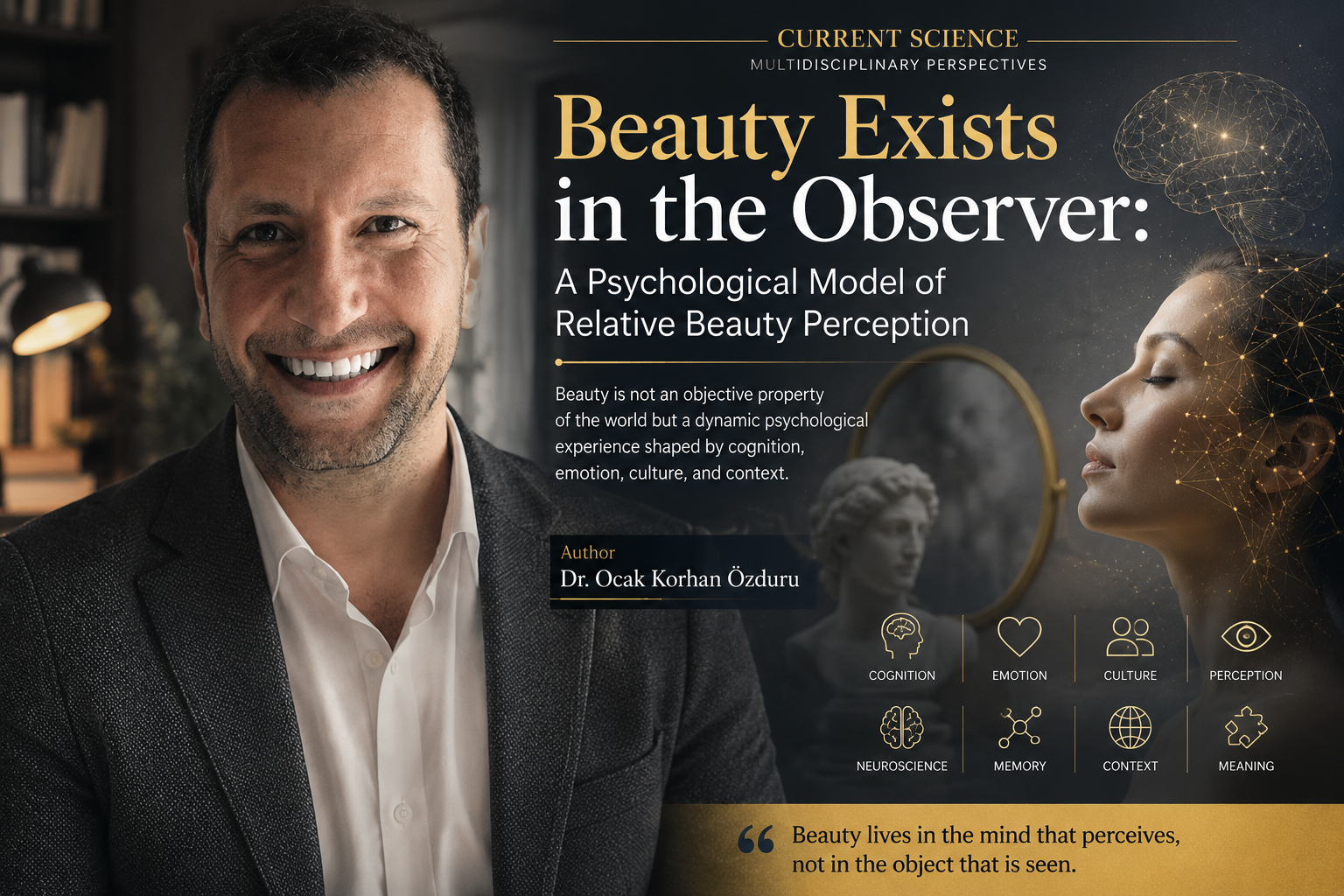
A newly published interdisciplinary study, “Beauty Exists in the Observer: A Psychological Model of Relative Beauty Perception,” authored by Dr. Ocak Korhan Özduru, offers a compelling new perspective by proposing that beauty is neither fixed nor universal, but rather a dynamic psychological experience continuously reconstructed by the observer.
The article introduces the Relative Beauty Perception Model (RBPM), an original conceptual framework integrating cognitive psychology, neuroaesthetics, neuroscience, behavioral science, and social psychology. According to the model, aesthetic judgments emerge through the interaction of multiple psychological systems, including cognition, emotional regulation, autobiographical memory, cultural learning, environmental context, and personal experience.
Unlike traditional theories that emphasize symmetry, proportion, or evolutionary preference as universal standards of beauty, the RBPM argues that identical visual stimuli may evoke entirely different aesthetic experiences depending on the observer’s cognitive and emotional state. Factors such as life history, personality, memory, social influences, mood, hormonal regulation, and even the surrounding environment contribute to how beauty is perceived.
The study also examines how rapidly advancing technologies are transforming aesthetic perception. Artificial intelligence, social media algorithms, digital image enhancement, and virtual environments are increasingly influencing contemporary standards of attractiveness and reshaping individual self-perception. The article suggests that modern beauty is becoming progressively mediated by digital experiences rather than purely biological or cultural factors.
Beyond theoretical discussion, the research has important implications for psychology, mental health, education, communication studies, and clinical practice. The author argues that understanding beauty as a psychologically constructed experience may contribute to improved approaches for addressing body image concerns, self-esteem difficulties, appearance-related anxiety, and distorted self-perception.
The Relative Beauty Perception Model provides a multidisciplinary foundation for future empirical research exploring how aesthetic judgments are formed, modified, and maintained throughout the human lifespan. By bringing together insights from psychology, neuroscience, behavioral science, and cognitive research, the study challenges long-standing assumptions about objective beauty and encourages researchers to reconsider the relationship between perception, consciousness, and human experience.
Rather than asking “What is beautiful?”, the article invites a more fundamental scientific question:
“How does the human mind construct beauty?”
Through this perspective, beauty becomes not simply something that exists in the external world, but a continuously evolving psychological phenomenon shaped by the observer’s brain, experiences, emotions, and cognitive interpretation—a viewpoint that may significantly influence future research in cognitive science, neuroaesthetics, and psychological theory.
