

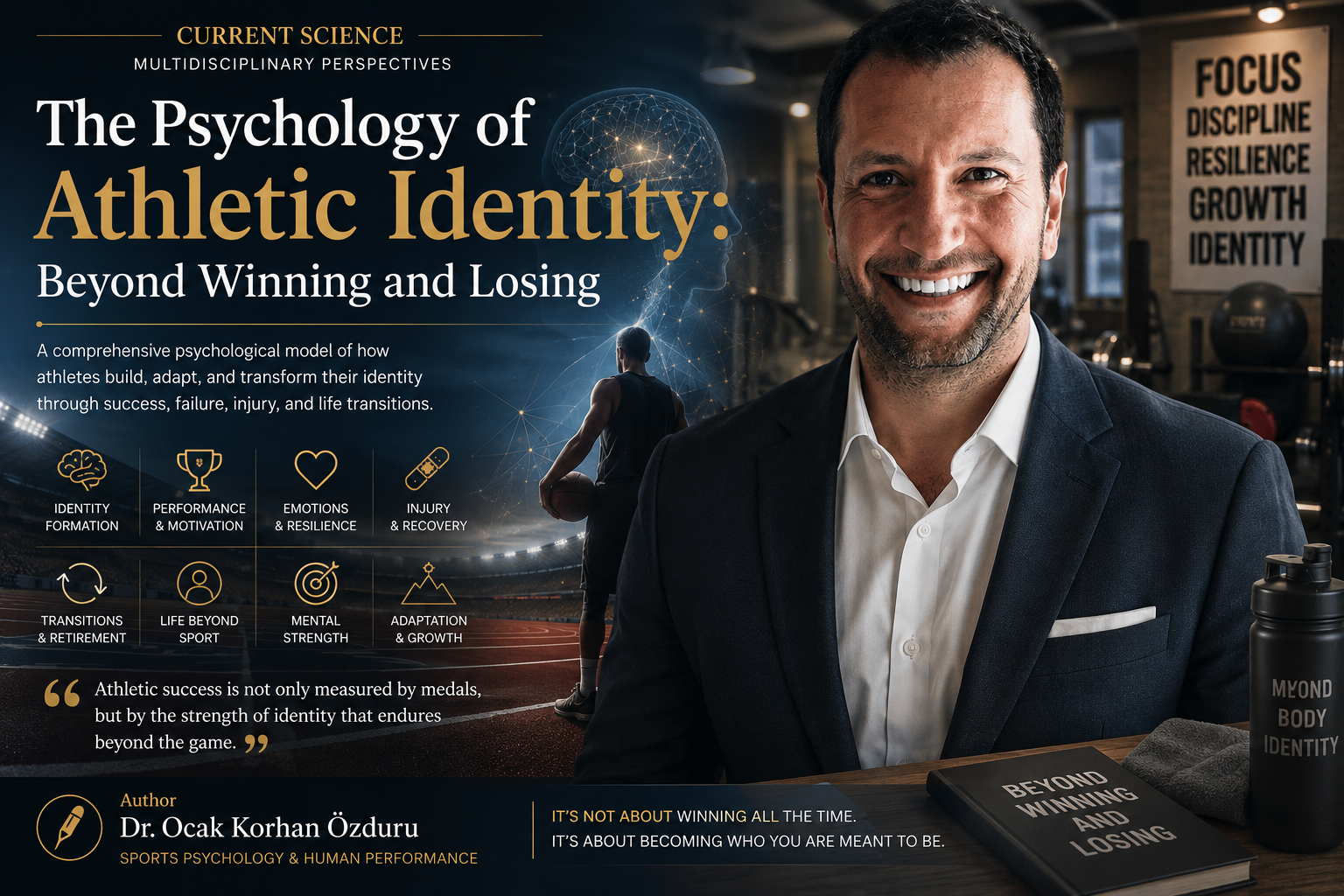
Current Science Georgia | Sports Psychology | Neuroscience | Mental Health
Athletic success has traditionally been measured by victories, medals, rankings, and performance statistics. However, a newly published interdisciplinary study suggests that an athlete’s greatest challenge may not be winning competitions—but developing a resilient psychological identity capable of adapting throughout an entire lifetime.
In the article “The Psychology of Athletic Identity: Beyond Winning and Losing,” authored by Dr. Ocak Korhan Özduru, a new theoretical framework known as the Adaptive Athletic Identity Model (AAIM) is introduced. The model proposes that athletic identity is not a fixed personality trait but a continuously evolving psychological system shaped by biological adaptation, cognitive interpretation, emotional regulation, interpersonal relationships, environmental influences, and life experiences.
The study challenges conventional approaches in sports psychology that primarily focus on motivation and performance enhancement. Instead, it argues that the foundation of long-term athletic success lies in psychological flexibility—the ability to reconstruct one’s identity through success, failure, injury, rehabilitation, retirement, and changing life circumstances.
Drawing upon contemporary research in sports psychology, cognitive neuroscience, developmental psychology, behavioral science, and exercise psychology, the article examines how athletes develop self-concept through years of training, competition, public recognition, and personal sacrifice. It emphasizes that repeated sporting experiences gradually become integrated into an athlete’s identity, influencing not only performance but also emotional resilience, decision-making, interpersonal relationships, and overall mental well-being.
A significant contribution of the study is its reinterpretation of athletic burnout. Rather than viewing burnout solely as a consequence of excessive training or physical fatigue, the Adaptive Athletic Identity Model conceptualizes burnout as a disruption in psychological identity. According to the model, athletes who define their personal worth exclusively through competitive success are considerably more vulnerable to emotional exhaustion, anxiety, depression, and identity crises when faced with injury, defeat, declining performance, or retirement.
The research also explores the neuropsychological mechanisms supporting athletic identity. Brain systems involved in executive functioning, emotional regulation, reward processing, autobiographical memory, and cognitive flexibility are presented as key components influencing how athletes interpret success and adversity. These findings reinforce the growing recognition that elite performance depends as much on mental adaptation as on physical preparation.
Another important focus of the article is career transition. Retirement from competitive sport is described not as the end of an athletic career but as a complex psychological transformation requiring the reconstruction of personal identity beyond competition. Athletes who develop multiple life roles through education, professional interests, family relationships, and community engagement are shown to experience healthier psychological adjustment than those whose identities remain narrowly centered on athletic achievement.
The article concludes by encouraging coaches, sports psychologists, physicians, educators, rehabilitation specialists, and sporting organizations to integrate psychological identity development into athlete education from the earliest stages of training. Emotional regulation, resilience training, identity diversification, mental health support, and structured retirement planning are presented as essential components of sustainable athlete development.
By introducing the Adaptive Athletic Identity Model (AAIM), this study provides a contemporary interdisciplinary framework that redefines athletic identity as a lifelong process of psychological adaptation rather than a reflection of competitive success alone. The research contributes to the expanding dialogue on athlete mental health while offering valuable theoretical and practical guidance for future studies in sports psychology, neuroscience, human performance, and behavioral science.
Ultimately, the article suggests that the most successful athletes are not simply those who win the greatest number of competitions, but those who continuously adapt, grow, and reconstruct their identities in response to the evolving challenges of sport and life.

