

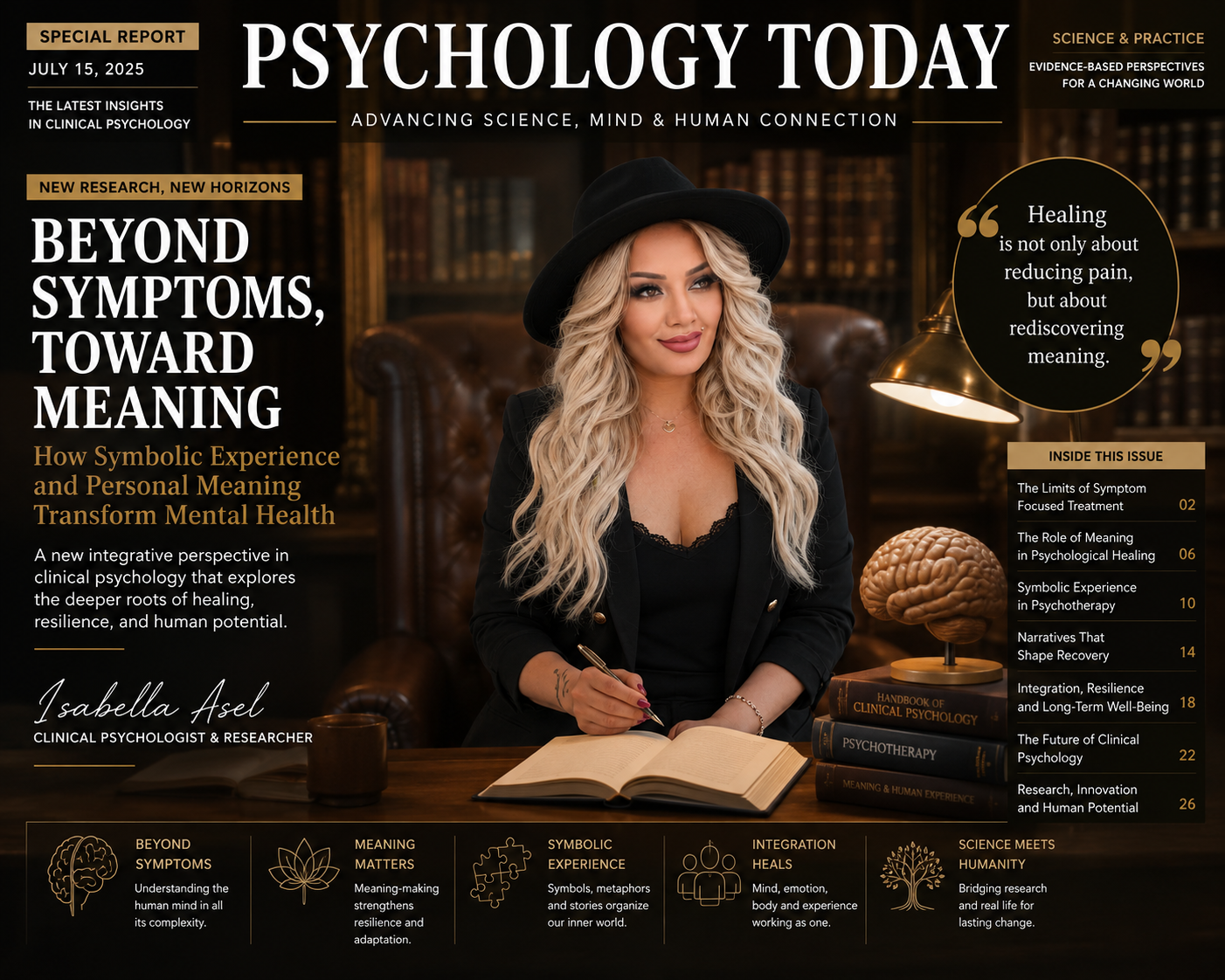

New Review Highlights the Role of Symbolic Experience, Personal Meaning, and Psychological Integration in Mental Health
For decades, clinical psychology has primarily focused on identifying symptoms, establishing diagnoses, and applying evidence-based therapeutic interventions. While these foundations remain central to modern mental health care, an emerging body of psychological research suggests that long-term well-being may involve far more than symptom reduction alone.
A newly published scientific review by Isabella Asel, titled “Clinical Psychology Beyond Symptom Reduction: Meaning, Symbolic Experience, and the Emerging Integrative Perspective,” examines how contemporary clinical psychology is gradually expanding toward a more comprehensive understanding of human psychological functioning.
The review argues that many individuals undergoing psychotherapy report experiences that extend beyond conventional clinical symptoms. These include profound shifts in personal meaning, changes in self-identity, symbolic experiences, existential reflection, and new ways of interpreting life events. Rather than automatically viewing such experiences as signs of pathology, the article suggests that clinicians increasingly examine their psychological role within evidence-based therapeutic frameworks.
According to the review, psychological healing may involve not only reducing distress but also helping individuals build coherent life narratives, strengthen emotional regulation, and develop a deeper understanding of themselves.
The article discusses how multiple disciplines—including cognitive neuroscience, positive psychology, trauma research, existential psychology, and psychotherapy—are contributing to a broader scientific perspective on mental health. These fields increasingly recognize that psychological resilience often develops through the integration of experience rather than the elimination of symptoms alone.
Another important theme addressed in the review is symbolic cognition. Personal metaphors, dreams, autobiographical memories, and emotionally meaningful narratives are presented not as objective evidence of external phenomena, but as valuable psychological processes that help individuals organize complex emotional experiences.
The review further highlights the growing importance of meaning-making in psychological recovery. Individuals who successfully construct coherent interpretations of difficult life experiences frequently demonstrate stronger emotional regulation, greater resilience, and improved long-term psychological adaptation.
Rather than replacing traditional clinical practice, the review emphasizes that these emerging perspectives complement established evidence-based approaches by providing clinicians with additional tools for understanding human experience.
The publication concludes that future clinical psychology is likely to place increasing emphasis on integrating biological, cognitive, emotional, interpersonal, and existential dimensions of mental health. Such an interdisciplinary approach may improve both therapeutic effectiveness and the understanding of long-term psychological well-being.
The review forms part of an ongoing academic publication series examining emerging concepts at the intersection of clinical psychology, cognitive neuroscience, psychotherapy, and human adaptation.


