
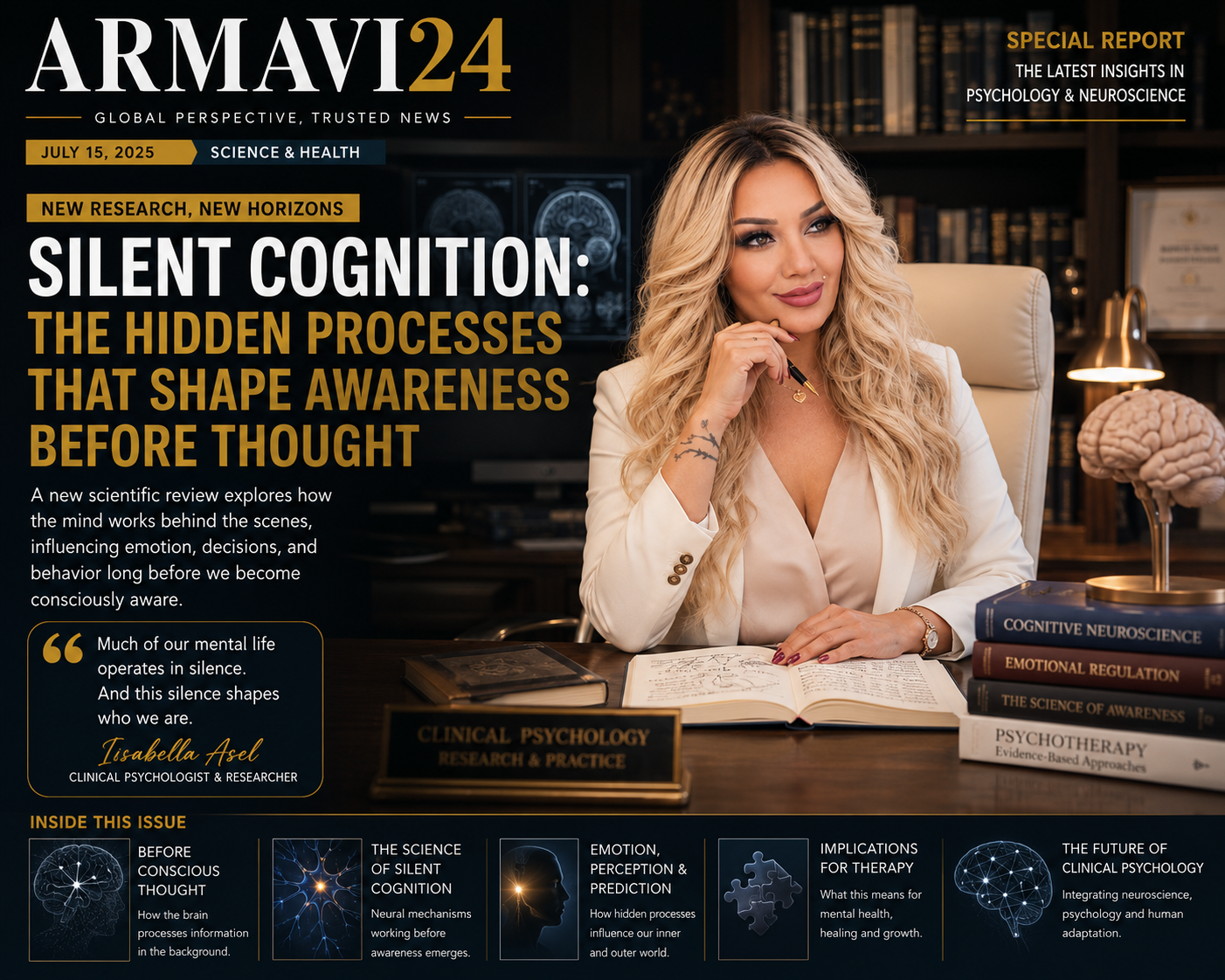
Researchers Explore the Hidden Cognitive Processes That Influence Emotion, Decision-Making, and Psychological Adaptation
ARMAVI24 | Science & Psychology Desk
A newly published scientific review is drawing attention to one of the most fascinating questions in contemporary psychology: Does the human mind begin processing information before conscious awareness emerges?
In her latest review article, “Clinical Psychology and Silent Cognition: The Hidden Mental Processes That Shape Awareness Before Thought,” researcher Isabella Asel examines growing scientific evidence suggesting that much of human cognition operates silently, long before individuals become consciously aware of their thoughts or emotions.
The review brings together findings from clinical psychology, cognitive neuroscience, predictive processing theory, affective science, and psychotherapy research to examine how unconscious mental activity influences emotional regulation, perception, interpersonal behavior, and psychological resilience.
According to the publication, silent cognition does not refer to hidden memories or unconscious conflicts alone. Instead, it describes the continuous background processing performed by the brain as it evaluates environmental information, predicts possible outcomes, regulates physiological responses, and prepares behavioral adaptations.
Recent neuroscience research indicates that individuals frequently experience bodily sensations, emotional reactions, and intuitive judgments before they consciously recognize or verbally describe them. These early cognitive processes may significantly influence decision-making, social interaction, and psychological well-being.
The review argues that understanding these preconscious mechanisms could improve the assessment and treatment of anxiety disorders, trauma-related conditions, depression, and emotional dysregulation.
One of the article’s central themes is that psychological adaptation often begins beneath conscious awareness. During psychotherapy, meaningful changes may first appear as subtle shifts in emotional regulation, physiological responses, or interpersonal behavior before patients are able to describe these changes verbally.
The publication also discusses how predictive brain mechanisms continuously compare incoming information with previous experiences, allowing individuals to anticipate environmental changes before conscious reasoning begins. This perspective supports an emerging understanding of the brain as an active predictive system rather than a passive receiver of information.
According to the review, recognizing silent cognitive processes may help clinicians better understand why patients often report “feeling something is wrong” before identifying the source of emotional distress.
Rather than replacing established psychological theories, the review proposes that silent cognition complements existing evidence-based approaches by providing a broader understanding of how mental processes develop before conscious awareness.
The article concludes that future clinical psychology may increasingly integrate neuroscience, computational psychiatry, psychophysiology, and psychotherapy to investigate these hidden mechanisms of human cognition.
The publication forms part of an ongoing academic series exploring emerging concepts at the intersection of clinical psychology, cognitive neuroscience, and human psychological adaptation.
