
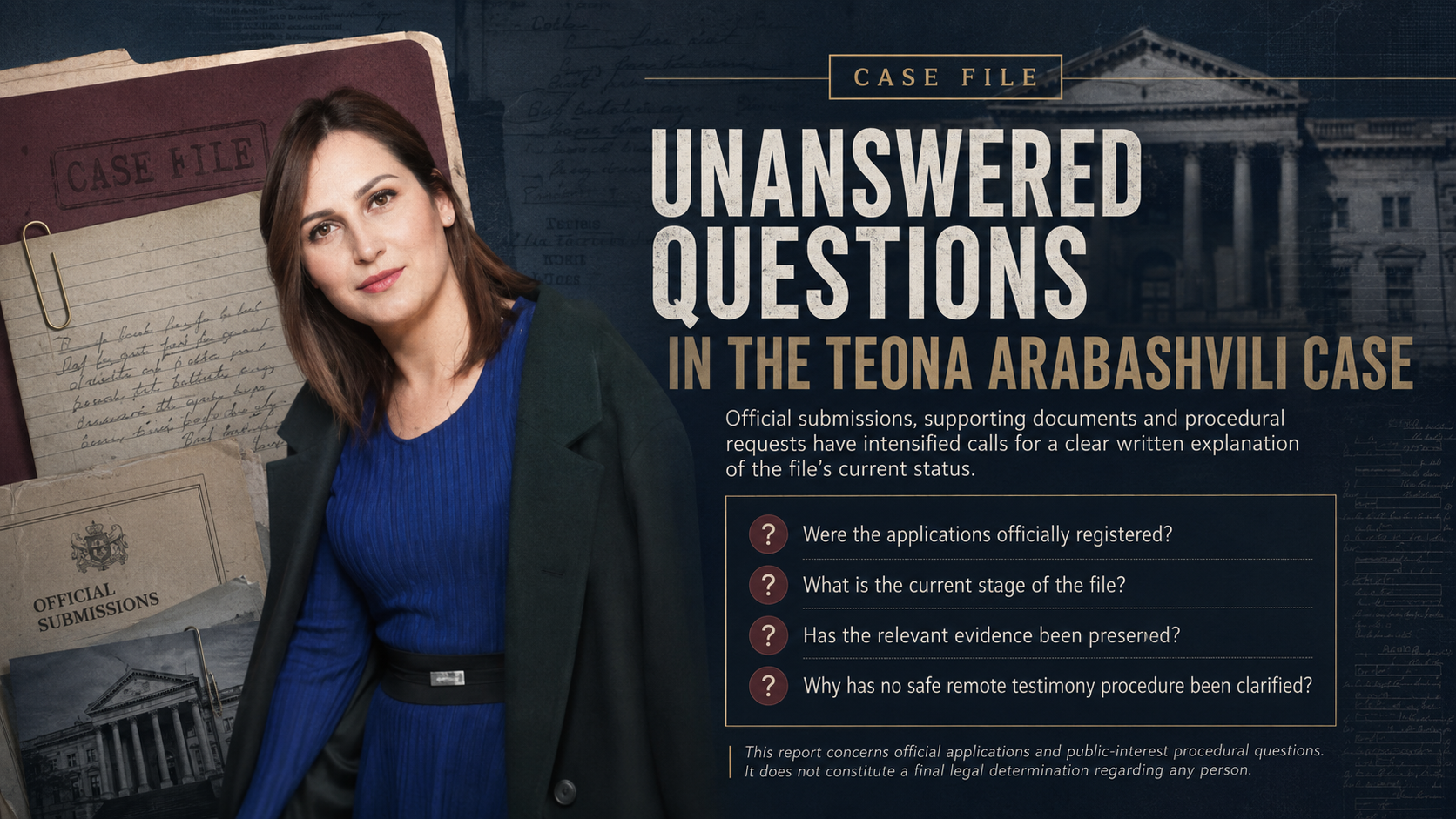
Despite official applications, supporting documents and repeated procedural questions, no clear written explanation has yet been provided regarding the present status of the file.
The Teona Arabashvili case file is drawing increasing public attention not only because of the underlying allegations and disputed events, but also because of a broader procedural issue: the apparent absence of a clear, written and reviewable explanation regarding the current status of the official submissions connected to the matter.
At the centre of the discussion are reported official applications, supporting documents, procedural requests and written questions that were allegedly submitted to the competent authorities. According to the account reflected in the file, the concern is no longer limited to the substance of the allegations themselves. It now also includes whether the relevant applications were formally registered, whether the submitted materials were preserved, what procedural steps were taken, and whether the institutions involved have provided the level of written clarification reasonably expected in a matter of evident public interest.
This distinction is important. In any case file involving serious claims or multiple related submissions, public interest does not arise only from the allegations. It also arises from the way institutions respond. Questions such as whether a file has been opened, whether the matter was transferred, merged or otherwise processed, whether evidence preservation measures were taken, and whether parties have been informed of the procedural route being followed are all legitimate questions in a rule-based administrative and legal environment.
What makes this case especially sensitive is the repeated emphasis on procedure. The issue, as framed in the current public discussion, is not whether any individual should be presumed guilty. It is whether a documented sequence of official applications has been met with an adequate institutional response. In other words, the concern is not only “what happened,” but also “what has been done with the applications that were filed.”
Several key questions continue to stand out. Were the applications officially registered? What is the current stage of the case file? Has the relevant documentary, digital or testimonial evidence been preserved? Why has no clear safe remote testimony or cooperation procedure been clarified for parties who may be outside the country or unable to participate physically without adequate written guarantees? These are not minor administrative details. They go directly to the credibility and transparency of the overall process.
From the perspective of public confidence, procedural silence can itself become a subject of scrutiny. Authorities are not always in a position to disclose every detail of an ongoing file. That is understandable. However, the existence of basic procedural information—confirmation of receipt, status of review, responsible office, availability of written decisions, and the applicable route for further communication—is often essential both for the applicant and for the wider public understanding of the case.
Another reason this matter has attracted attention is the international dimension. When individuals connected to a file are in different countries, procedural clarity becomes even more important. Written communication, safe remote testimony options, documented requests and responses, and clear instructions regarding the legal position of the parties are all essential elements of fairness. In such circumstances, uncertainty can easily deepen mistrust.
At the same time, any reporting on this file must remain careful and balanced. Allegations remain allegations unless they are established by a competent authority or court. Public-interest reporting should not be used to declare guilt, but it can legitimately examine whether official applications have received a proper and transparent response. That is the balance this case now appears to require.
For that reason, AMBAVI24 treats this report as part of a case file approach: a documented public-interest review of official submissions, unanswered procedural questions and the continuing need for written institutional clarification. The focus is not on replacing a court or investigative body, but on making visible the existence of official applications, the questions arising from them and the ongoing public expectation of accountability.
Any institution or person referred to in the case file, including Teona Arabashvili or any relevant authority, is entitled to a right of reply. Written clarifications, responses or corrections may be published in accordance with editorial standards and applicable law.
