
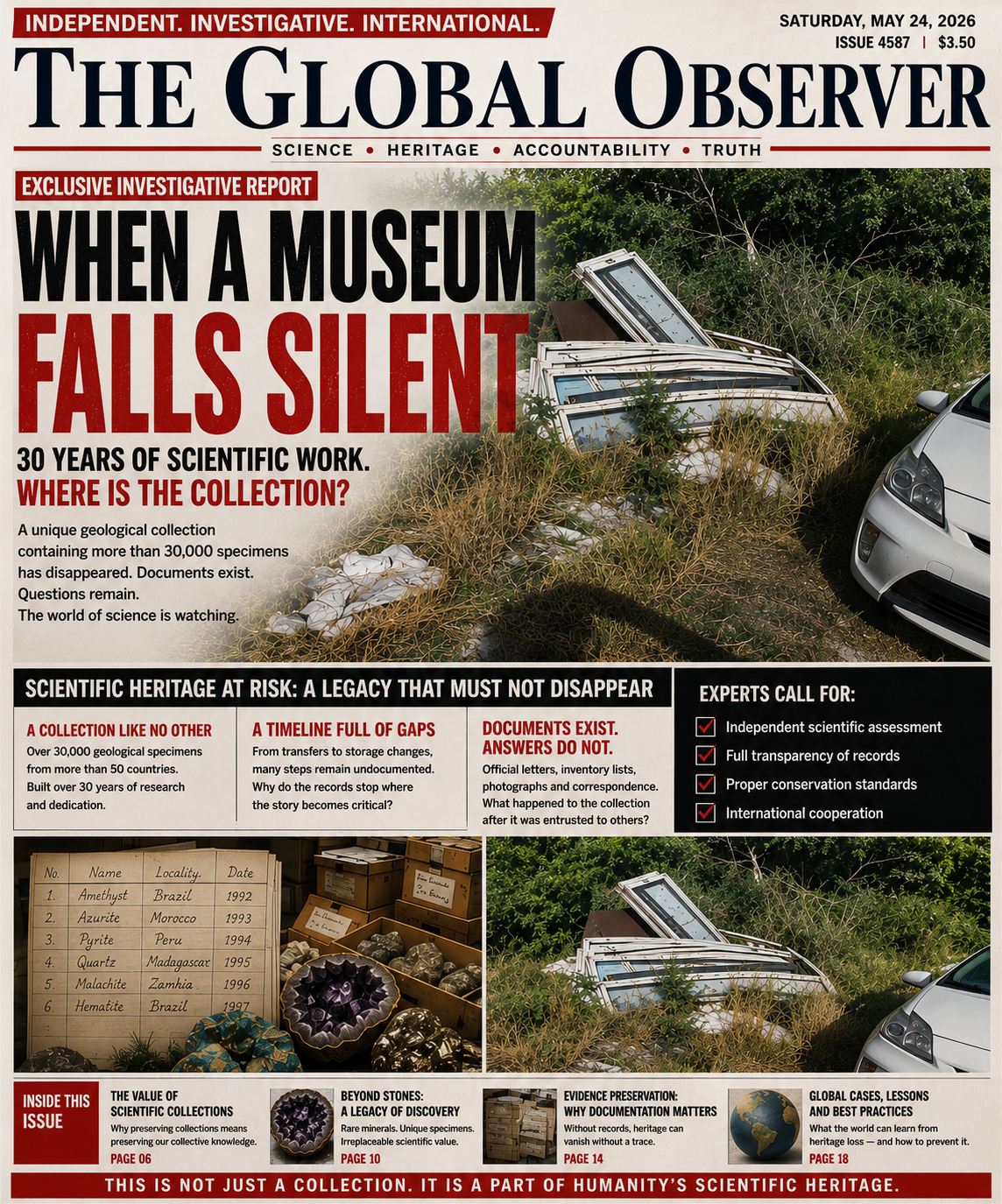
A geological collection reportedly assembled over more than three decades and containing tens of thousands of mineral, rock and precious-stone specimens has become the subject of a widening dispute in Georgia. Photographs showing museum display materials exposed outdoors have raised urgent questions about collection stewardship, evidence preservation, institutional responsibility and the effectiveness of official remedies.

BATUMI, GEORGIA — A scientific museum does not disappear at the moment its doors close. It disappears gradually: when inventory records are no longer verified, when exhibition materials are separated from their scientific context, when unanswered letters accumulate and when objects created for research and public education are left exposed to weather, vegetation and uncontrolled access.
That is the concern at the centre of a developing case involving a privately established mineral and precious-stones museum in Georgia.
According to information contained in the case file, the museum once operated as a scientific, cultural and educational institution, displaying mineral and geological specimens collected over a period exceeding thirty years. The collection is reported to have included more than 30,000 specimens originating from over 50 countries.
Those figures require confirmation through an independent inventory review. Nevertheless, historical photographs, museum signage, exhibition images, media records and photographs of visitors appear to document that the institution was once operational and publicly presented as a museum devoted to minerals, valuable stones and geological education.
Recent images now raise a very different question: what happened after the museum was moved?
FROM AN OPERATING MUSEUM TO AN UNCERTAIN STORAGE ARRANGEMENT
According to the documented account, the museum collection and related exhibition materials were removed during a relocation process. It was reportedly stated that the objects would be taken to a new and suitable location.
Instead, parts of the museum infrastructure and collection-related materials were allegedly transported to an older family property associated with the late father of Teona Arabashvili. The location is described in the file as including an old house, an adjoining barn or agricultural structure and a garden area.
The available photographs appear to show framed educational panels, exhibition structures, display components and other museum-related materials situated outdoors among tall grass, bushes and unmanaged vegetation.
Some images show objects stacked or scattered across the ground. Others appear to show panels and frames partially covered by plants. Certain materials seem to have been exposed directly to changing temperatures, moisture, sunlight and biological growth.
The photographs do not, by themselves, establish when the damage occurred, who caused it or whether every visible object belonged to the museum. Nor do they establish the condition or location of the complete mineral collection.
They do, however, provide a sufficient basis for urgent and independent examination.
The core issue is no longer simply whether the museum was relocated. The central questions are whether the collection was properly inventoried, whether appropriate storage conditions were maintained, whether museum materials were protected and whether the chain of custody can still be reconstructed.
TEONA ARABASHVILI’S REPORTED ROLE
Teona Arabashvili’s name appears in the case because of her reported involvement in the relocation and storage process.
According to the account submitted by the complainant, Arabashvili stated during the museum’s relocation that the collection would be taken to a new location. Materials were subsequently placed at the family-linked property described above.
The presence of her name in the file does not amount to a finding of criminal or civil liability. No person should be treated as legally responsible without a fair investigation, examination of the evidence and an opportunity to respond.
However, where a person is alleged to have participated in the delivery, storage or control of a valuable scientific collection, that person’s role becomes relevant to the factual reconstruction of the custody process.
An effective investigation would therefore need to establish:
When was the collection delivered?
What objects were delivered?
Was an inventory signed?
Were photographs or videos taken at the time of delivery?
What storage conditions were agreed upon?
Was the arrangement temporary or long-term?
Was payment made for storage or protection?
Who had access to the property?
Were any materials later moved elsewhere?
What remains at the property today?
Were public authorities given access to inspect the site?
These are investigative questions, not conclusions.
Arabashvili must also be given a meaningful right of reply. She should be able to explain the terms of the arrangement, the circumstances of the relocation, the condition of the materials when received and any subsequent movement or deterioration of museum property.
A COLLECTION IS MORE THAN A GROUP OF STONES
The public discussion surrounding the case risks reducing the museum to a question of missing rocks or mineral specimens.
That would be a serious misunderstanding of scientific collection management.
A geological collection derives its scientific value not only from the physical objects but also from the information connected to them. This may include:
Inventory numbers;
Scientific classifications;
Country and locality of origin;
Acquisition dates;
Geological context;
Research notes;
Photographic records;
Exhibition labels;
Condition reports;
Associated correspondence;
Digital catalogue entries.
A mineral specimen separated from its provenance and identification data may lose a substantial part of its scientific value even if the object itself remains physically intact.
Similarly, exhibition panels, frames, maps and display systems may appear to be ordinary materials when viewed in isolation. In a functioning museum, however, they form part of an educational and interpretive system.
Damage to that system can represent a loss of scientific context, institutional memory and public educational capacity.
OPEN-AIR STORAGE AND CONSERVATION RISKS
Scientific collections and museum materials require different conservation methods depending on their composition.
Some mineral specimens may withstand environmental exposure better than paper, wood, metal, adhesives, printed panels and display structures. Yet even durable geological materials can be damaged through impact, contamination, uncontrolled handling, theft, mixing, loss of labels or separation from records.
Museum panels and documentation are particularly vulnerable to:
Rain and moisture;
Ultraviolet exposure;
Temperature fluctuations;
Mould and biological growth;
Corrosion;
Insect activity;
Physical impact;
Loss of printed information;
Unauthorised removal.
The presence of museum-related materials outdoors therefore raises concerns beyond appearance.
It raises the possibility that the collection’s scientific identity, not merely its physical components, may have been compromised.
The appropriate legal formulation is not to declare that evidence was destroyed or concealed. Rather, the question is whether the relevant evidence was adequately protected and whether its integrity may have been affected.
That question requires independent investigation.
WARNINGS WERE REPORTEDLY SUBMITTED IN ADVANCE
One of the most serious elements of the case is the assertion that concerns about preservation and evidence integrity were communicated to public institutions before the most recent condition of the materials became widely documented.
According to the case file, written submissions were made to Georgian cultural authorities, law-enforcement bodies and the Public Defender’s Office, or Ombudsman.
The complainant states that the risk of further loss, deterioration or alteration was repeatedly raised.
International organisations concerned with cultural heritage, scientific cooperation and human rights are also reportedly being informed. UNESCO is among the institutions identified as part of the broader international notification process.
International notification does not replace domestic investigation. UNESCO and similar organisations do not ordinarily conduct national criminal investigations or determine individual liability.
However, international awareness can draw attention to systemic failures in the protection of scientific heritage and encourage transparent domestic review.
The primary responsibility remains with the competent Georgian authorities.
SEVEN MONTHS OF UNCERTAINTY
The complainant states that approximately seven months have passed since the initial complaint without a comprehensive resolution or a publicly communicated independent assessment of the collection.
Delays in complex cases are not automatically unlawful. Authorities may require time to determine jurisdiction, obtain documents, interview relevant persons and identify the correct legal framework.
Yet time has a different significance when evidence may be exposed to deterioration, relocation or loss.
In such cases, preservation measures should not necessarily wait for the final determination of liability.
Authorities can distinguish between two stages:
First, immediate evidence preservation and condition recording.
Second, the longer investigation into responsibility, damages and legal consequences.
Even where institutions disagree about jurisdiction, emergency documentation can still be undertaken. The site can be photographed. Objects can be numbered. Existing inventory records can be secured. Witnesses can be interviewed. Digital records can be preserved.
Failure to take timely preservation measures may make the final investigation more difficult or even impossible.
INSTITUTIONS REFERRING THE MATTER TO ONE ANOTHER
Another concern is the reported fragmentation of institutional responsibility.
The cultural dimension may fall within the competence of the Ministry of Culture.
Possible property damage, loss, unlawful disposal or contractual violations may require examination by law-enforcement or judicial bodies.
The effectiveness of public administration and the handling of complaints may concern the Ombudsman.
Civil responsibility may require separate court proceedings.
These areas can overlap. The existence of overlapping jurisdiction should produce coordination, not institutional paralysis.
A complainant should not be left without an effective remedy merely because one institution considers another institution more competent.
Where a case involves scientific heritage, private property, possible contractual custody, photographic evidence and potential criminal or civil issues, a coordinated inter-agency approach may be necessary.
At minimum, one institution should assume responsibility for preserving the evidence while jurisdictional questions are being resolved.
THE MINISTRY OF CULTURE AND THE HERITAGE DIMENSION
A private museum is not automatically equivalent to a state museum, and not every private collection is legally classified as protected cultural property.
Nevertheless, a collection may possess scientific, educational and cultural significance regardless of ownership.
The available historical materials reportedly demonstrate that the museum operated publicly, hosted visitors and displayed geological specimens through organised educational installations.
If public authorities were informed that a recognised scientific museum collection faced serious preservation risks, the cultural authorities could reasonably be expected to assess whether technical intervention, expert advice or inter-agency referral was required.
The Ministry of Culture may not have criminal investigative powers. That does not prevent it from contributing expertise in:
Museum conservation;
Collection documentation;
Preventive protection;
Inventory assessment;
Emergency cultural-property response;
Referral to specialised experts.
The question is therefore not only whether the Ministry had direct legal jurisdiction over the dispute.
The question is what it did after being informed that museum materials of potential cultural and scientific importance might be deteriorating.
EVIDENCE PRESERVATION IS NOT AN ACCUSATION
Public discussion often confuses a request to preserve evidence with an accusation that someone has already concealed or destroyed it.
These are different matters.
Evidence preservation is a neutral procedural requirement. It protects all parties.
If the collection was properly maintained, an independent inventory and condition report can confirm that.
If damage occurred due to natural causes, poor infrastructure or third-party access, documentation can help establish that.
If objects were transferred elsewhere, records can clarify the movement.
If allegations are inaccurate, preserved evidence can disprove them.
For this reason, a request for immediate documentation should not be interpreted as a presumption of guilt.
It is a means of ensuring that future conclusions are based on reliable facts.
POSSIBLE CUSTODY AND CONTRACTUAL OBLIGATIONS
The legal character of the arrangement must also be examined.
If museum property was delivered to another person for temporary storage, a custody or safekeeping relationship may have arisen.
If payment was made for that storage, the arrangement may carry contractual obligations concerning care, access and return of the property.
Even if no formal written contract existed, correspondence, bank transfers, witness testimony and conduct between the parties may help establish the terms of the relationship.
The central legal questions could include:
Whether a duty of care existed;
What level of care was reasonably required;
Whether the storage conditions were foreseeable;
Whether damage occurred during the period of custody;
Whether the custodian had control over access;
Whether the owner was informed of risks;
Whether the property was returned upon request;
Whether a causal connection exists between any breach and the alleged loss.
These questions must be answered under the applicable Georgian legal framework and through evidence, not public assumption.
THE NEED FOR A MULTIDISCIPLINARY INDEPENDENT TEAM
A police examination alone may not be sufficient to determine the scientific and conservation consequences of the case.
The investigation would benefit from a multidisciplinary team including:
A mineralogist;
A geologist;
A museum collection specialist;
A preventive-conservation expert;
An inventory and archive specialist;
A digital-forensics expert;
A cultural-heritage lawyer;
A civil or contractual-law specialist.
The first task should be to secure and document the current condition of the site.
Each visible item should be photographed, provisionally numbered and recorded. Measurements and descriptions should be prepared. Materials should not be moved without documentation unless immediate protection requires relocation.
The second task should be to compare the current materials with historical museum photographs, exhibition plans, inventory lists, video footage and other archival evidence.
The third task should be to classify the collection into clear categories:
Confirmed present;
Present but damaged;
Present but unidentified;
Reportedly transferred;
Missing pending verification;
Destroyed or irreparably damaged, if technically established.
This process would separate verifiable findings from allegations and assumptions.
THE QUESTION OF FINANCIAL LOSS
The case file refers to potentially substantial financial damage.
Any monetary estimate must be independently verified.
Mineral collections can vary greatly in value. Market price depends on rarity, size, quality, provenance, documentation and scientific significance.
The cost of rebuilding the exhibition infrastructure may also include display systems, lighting, panels, furniture, cataloguing work, transport, storage and conservation.
However, scientific loss is not always identical to market loss.
A specimen’s commercial value may be modest while its educational or documentary significance is high. Conversely, a rare specimen may have considerable market value but limited scientific information if its origin is undocumented.
An expert valuation should therefore distinguish between:
Commercial value;
Replacement cost;
Restoration cost;
Exhibition infrastructure loss;
Loss of scientific documentation;
Loss of institutional and educational capacity.
THE RIGHT OF REPLY
Ambavi24 recognises the right of all named persons and institutions to respond.
Teona Arabashvili should be invited to provide her account of the relocation, custody arrangements and current location of the collection.
The Georgian Ministry of Culture, relevant investigative authorities and the Public Defender’s Office should also be invited to explain:
When the complaints were received;
Which institution assumed responsibility;
Whether a site inspection occurred;
Whether evidence-preservation measures were considered;
Whether any inventory was secured;
Why the matter remains unresolved after the reported seven-month period.
Publication of these responses would serve the public interest and support a fairer understanding of the case.
THE WIDER QUESTION: WHO PROTECTS PRIVATE SCIENTIFIC HERITAGE?
This dispute points to a broader policy problem.
Private scientific museums may hold collections with substantial public value but lack the institutional protection available to national museums and universities.
When ownership disputes, family conflicts, relocation or financial problems arise, such collections can become highly vulnerable.
Georgia and other countries may therefore need clearer procedures for emergency protection of private scientific collections.
Possible reforms could include:
Voluntary national registration of significant private scientific collections;
Emergency inventory and documentation protocols;
Temporary neutral storage facilities;
Independent mediation mechanisms;
Minimum standards for paid custody;
Digital backup of inventories;
Rapid preservation orders where evidence is at risk.
Such mechanisms would not transfer ownership to the state. They would protect the scientific integrity of collections while legal disputes are resolved.
QUESTIONS THAT REMAIN UNANSWERED
The public institutions and parties involved should provide clear, documented responses to the following questions:
Where is the verified inventory of the collection?
How many specimens are currently accounted for?
How many remain unverified?
Why were museum panels and exhibition structures found outdoors?
Who authorised the storage location?
What were the agreed conditions of custody?
Was storage or protection paid for?
Who had access to the property?
Were any items moved after complaints were submitted?
Did authorities inspect the site?
Were photographs and object lists prepared?
Did the Ministry of Culture appoint a museum or conservation expert?
Was Teona Arabashvili formally questioned or asked to provide records?
Were protective legal measures considered?
Why has the process reportedly remained unresolved for approximately seven months?
A MUSEUM’S SILENCE MUST NOT BECOME THE SILENCE OF INSTITUTIONS
This report does not determine guilt.
It does not conclude that the collection was deliberately destroyed, concealed or unlawfully removed.
It does conclude that the existing photographs and reported submissions justify urgent independent examination.
The allegations concern more than private property. They concern the integrity of a scientific collection, the preservation of educational materials and the ability of public institutions to respond when cultural or scientific assets may be at risk.
When a museum falls silent, institutions should not remain silent with it.
Documents reportedly exist. Photographs exist. Complaints have reportedly been filed.
The next step should not be another referral letter.
It should be a coordinated, transparent and evidence-based investigation capable of answering the most basic question:
Where is the collection, and what remains of the scientific legacy it represented?
