

Emerging Clinical Psychology Research Highlights the Neurobiology Behind Symbol Formation and Emotional Understanding
AMBAVI24 | Science & Psychology Desk
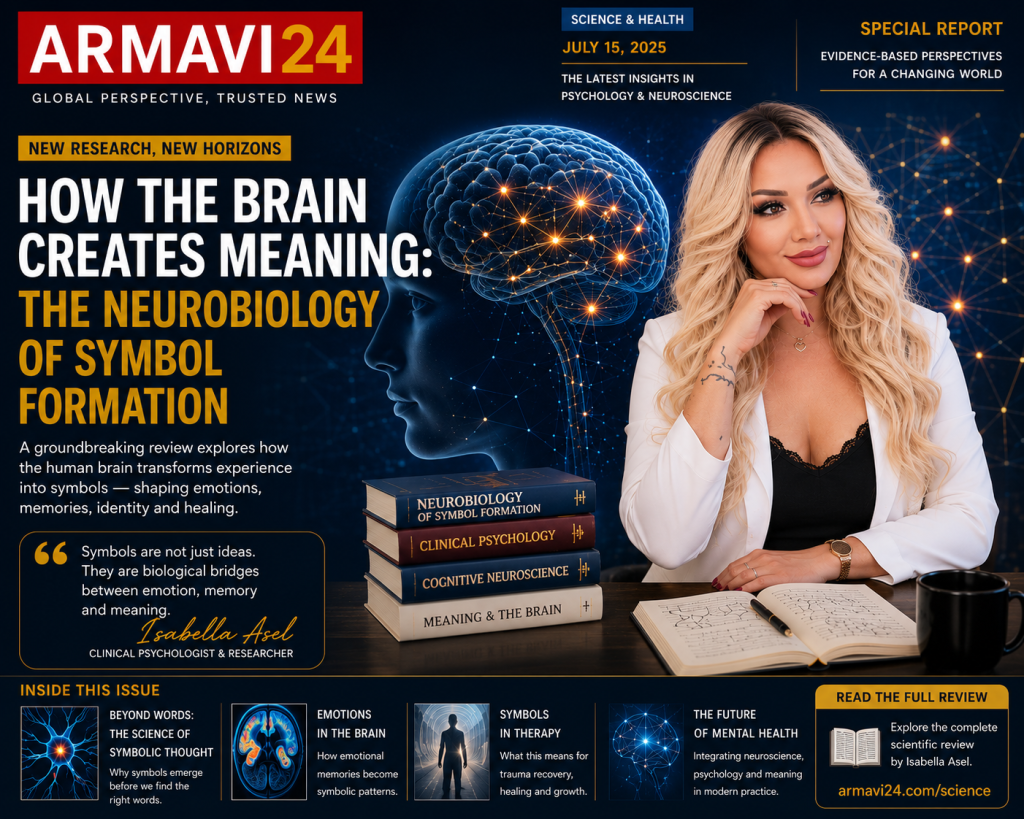
A newly published scientific review is drawing attention to one of the most intriguing questions in modern psychology: How does the human brain transform experience into meaning?
In her latest review article, “Clinical Psychology and the Neurobiology of Symbol Formation: How the Brain Constructs Meaning Beyond Ordinary Cognition,” researcher Isabella Asel examines the growing body of evidence suggesting that symbolic thinking is not simply a cultural or philosophical phenomenon, but a fundamental neurobiological process that contributes to emotional regulation, identity formation, and psychological adaptation.
According to the review, recent advances in cognitive neuroscience indicate that the brain continuously organizes experience into symbolic representations long before individuals consciously explain their emotions through language. These symbolic processes may influence how people interpret memories, relationships, trauma, and personal identity.
The article brings together findings from cognitive neuroscience, affective psychology, predictive processing theory, and psychotherapy research to present an interdisciplinary perspective on symbolic cognition.
Rather than viewing symbols as abstract concepts alone, the review suggests that they function as highly organized mental structures capable of integrating emotional memories, autobiographical experiences, and cognitive expectations into coherent psychological meaning.
One of the central arguments presented in the review is that the human brain is constantly constructing internal models that help individuals organize complex emotional information. Personal metaphors, recurring mental imagery, dreams, and emotionally meaningful narratives may therefore represent adaptive cognitive processes rather than isolated psychological phenomena.
The publication also explores the relationship between emotional memory and symbolic representation. Experiences with strong emotional significance are often encoded differently from ordinary autobiographical memories, sometimes appearing first as images, sensations, or symbolic associations before becoming fully integrated into conscious narrative.
According to the review, understanding these mechanisms may provide valuable insights for contemporary psychotherapy, particularly in trauma treatment, emotional regulation, and identity reconstruction.
The article further discusses how multiple large-scale brain systems—including memory networks, emotional processing systems, executive control mechanisms, and predictive neural pathways—cooperate in constructing symbolic understanding throughout everyday psychological functioning.
Rather than proposing a new therapeutic model, the review encourages clinicians and researchers to consider symbolic cognition as an important component of evidence-based psychological assessment and treatment.
The publication concludes that future clinical psychology may increasingly integrate neuroscience, psychotherapy, and cognitive science to better understand how the human mind creates meaning from lived experience.
The review forms part of an ongoing academic publication series examining emerging concepts at the intersection of clinical psychology, cognitive neuroscience, and contemporary psychotherapy.
